6 AI Trends to Master in 2026: Workflows, Context, and Physical AI
Explore the six most impactful AI trends for 2026, from the shift to AI workflows and the importance of context to the rise of physical AI and the end of the technical divide. Learn practical takeaways from McKinsey, OpenAI, and Stanford reports to navigate the evolving AI landscape.
IngestGPT
Admin
Introduction
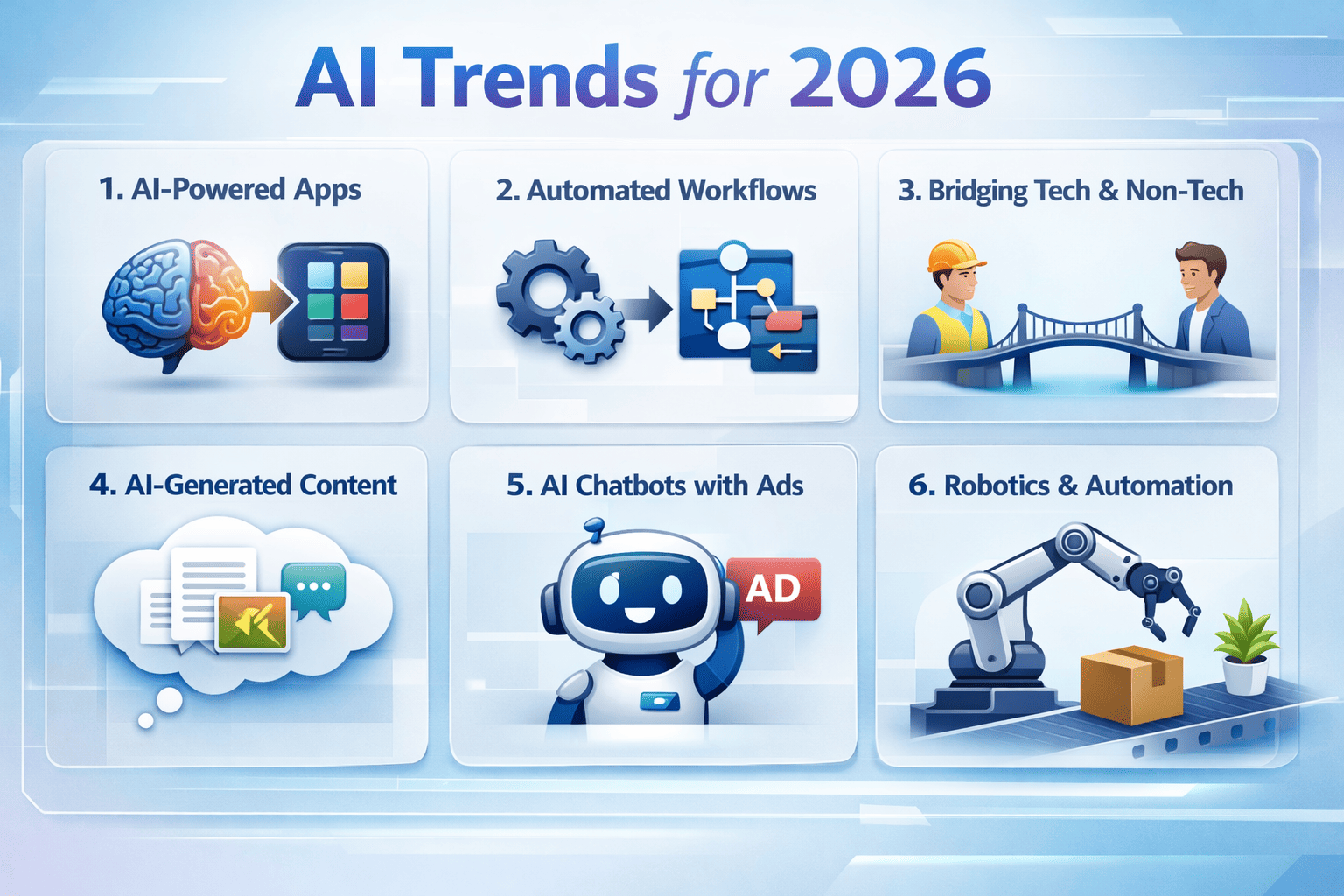
The landscape of Artificial Intelligence is evolving at an unprecedented pace, making it crucial to understand the shifts that will define its impact in the coming years. For 2026, a set of six pivotal AI trends stands out, shaped by daily research and reports from leading institutions such as McKinsey, OpenAI, and Stanford. This exploration aims to provide a clear sense of where AI is heading and, more importantly, what practical steps individuals and organizations can take to leverage these advancements. We'll delve into each trend, starting with the broader context and moving towards actionable takeaways, helping you navigate the future of AI.
Trend Number One: Models Don't Matter Much Anymore
The Big Picture For years, the release of new AI models ignited fervent debates about which one was "the best," a valid discussion given the significant quality differences. However, by 2026, the choice of a specific model will diminish in importance. Data indicates a clear trend: major AI models are still improving in absolute terms, but the performance gap between them is steadily shrinking. This convergence means no single model maintains a decisive lead. A Stanford study further supports this, showing that open-weight alternatives like DeepSeek and Llama are now approaching the frontier performance of closed models such as Gemini and ChatGPT.
Beyond performance, cost is another critical factor. Epoch AI data reveals that the expense of utilizing powerful models has drastically decreased, partly due to more efficient hardware. For instance, NVIDIA's latest chips are 105,000 times more energy-efficient per token than those from a decade ago.
The Shift When products become both cheaper and more similar, they inevitably commoditize. Just as one doesn't typically ask "Who provides the best electricity?" but rather "What can I use the electricity for?", the focus in AI is shifting. The competition is moving away from the raw AI model itself and towards the "app layer"—the way we actually use the AI. This mirrors the automotive industry, where once the engine became standardized, the focus shifted to features and design.
This dynamic creates distinct advantages for frontier AI labs. OpenAI, for example, holds a mindshare advantage, with ChatGPT being synonymous with AI and commanding the largest market share. Google benefits from a distribution advantage, with Gemini deeply embedded across its existing products like Search, Gmail, and Android, and its extensive integration within Google Workspace. Anthropic, on the other hand, possesses a specialization advantage, cultivating a loyal customer base among developers and enterprise clients. Notably, none of these advantages stem from having the "best AI"; instead, success is now defined by reach, integration, and trust.
Practical Takeaways Stop fixating on technical scores or the absolute "best" model. Instead, prioritize how an AI model fits into your actual workflow and specific needs. The true value lies in its application and integration, not its raw power.
Trend Number Two: 2026 is the Year of AI Workflows, Not AI Agents
The Big Picture A common observation on platforms like Twitter and LinkedIn is the industry's rapid leap from chatbots directly to autonomous agents, often bypassing the crucial intermediate step where genuine value is unlocked: AI workflows. The numbers firmly support this assessment. According to McKinsey, fewer than 10% of organizations across any business function report successfully scaling true agents. In stark contrast, OpenAI's enterprise report reveals that 20% of enterprise AI use is already occurring through workflow-specific tools such as Custom GPTs and projects. This significant gap demonstrates a clear market preference for workflows over full autonomy.
Andrej Karpathy aptly summarizes this sentiment, stating that "Calling everything an agent creates unrealistic expectations and confusion." Fully autonomous AI continues to face substantial hurdles, particularly concerning data security. This suggests that we are looking at the "decade of agents," rather than the "year." By integrating tools like Custom GPTs into existing workflows, we effectively create an "agent-light" solution, which proves far more reliable in consistently producing results.
The Impact and Value This shift is playing out across diverse industries. A pharmaceutical company, for instance, redesigned its clinical study workflow by leveraging AI to analyze raw clinical data, allowing human experts to focus on validation. This resulted in a 60% reduction in prep time and 50% fewer errors. Similarly, a utility company optimized its call center workflow, where AI now handles authentication and routine inquiries, leading to a 50% cut in cost per call while simultaneously boosting customer satisfaction scores by 6%. A bank implemented AI into its code migration workflow, using it to scan legacy code and generate updated versions for developers to verify, effectively cutting the required human hours by 50%.
McKinsey predicts that redesigning workflows will unlock nearly $3 trillion in economic value by 2030. Crucially, organizations that adopt this approach will also develop the "muscle memory" necessary to more rapidly integrate true AI agents when they eventually arrive.
Practical Takeaways Your primary goal for 2026 should be to transform your successful prompts into repeatable workflows. Select one recurring deliverable you produce, such as a weekly report. Break it down into discrete steps, and then strategically assign the predictable components to AI. Always keep yourself in the loop for the final judgment calls and critical decisions. This structured approach is the foundation for true reliability and consistent results.
Trend Number Three: The End of the Technical Divide
The Big Picture Historically, non-technical teams within organizations, such as sales and marketing, often depended on specialist technical teams for tasks like building dashboards. This reliance frequently led to deprioritized requests, especially for projects deemed "low impact." However, 2026 marks a significant reduction in this technical divide. The data supporting this trend is compelling.
OpenAI's latest report indicates that 75% of enterprise users reported utilizing AI to accomplish tasks they "literally could not do before"—not merely performing existing tasks faster, but achieving entirely new capabilities. Evidence of this transformation is seen in the 36% growth in coding-related messages from non-technical employees in just six months. This surge comes from salespeople, marketers, and operations managers who are now writing scripts, automating spreadsheets, and building internal tools independently. A study from MIT further confirms this, highlighting AI's role as an equalizer that disproportionately assists workers with lower technical skills in closing the performance gap with experts.
Career Implications For individuals whose value is purely technical—for instance, the "dashboard person"—their competitive advantage is diminishing. The marketing manager who once waited in a queue for assistance can now often achieve these tasks independently. Conversely, if you are that marketing manager or a salesperson with deep client understanding and domain expertise, this represents one of the most significant opportunities of your career. The technical barriers that previously separated your expertise from its execution are now largely removed.
Practical Takeaways This month, attempt one task you previously considered "impossible" or would typically outsource. Identify a technical project, such as constructing a dashboard, cleaning a complex data set, or automating a report. Then, try to accomplish it yourself using AI tools like Gemini, Claude, or ChatGPT. You'll likely be surprised by your newfound capabilities.
Trend Number Four: From Prompting to Context
The Big Picture While effective prompting has been a cornerstone of interacting with AI, this emphasis is set to diminish in 2026. Newer models have significantly improved their ability to comprehend vague instructions. However, they retain a critical weakness: the "fact gap." Although models possess vast knowledge from the public internet—ranging from Shakespeare to Python code—they inherently lack context specific to your individual or organizational needs, such as your Q3 goals, brand guidelines, or that crucial email from your boss yesterday. This is akin to having a brilliant employee who knows how to perform tasks but is denied access to any company files; they will inevitably struggle due to a lack of context.
The Shift The focus is therefore shifting from "how we ask" (the precise wording of a prompt) to "what we give it" (the relevant context). This fundamental change explains the ongoing "platform wars" in the AI space. Companies like Google and Microsoft are aggressively embedding AI into their productivity suites. The rationale is clear: whoever controls your context—your emails, your documents, your calendar—will command your attention. This also facilitates platform lock-in; the more context you accumulate within a single ecosystem, the smarter and more personalized the AI becomes for you, making it increasingly difficult to switch to an alternative platform.
Practical Takeaways There are two crucial takeaways, particularly for those not directly involved in productivity software development.
- File management is no longer optional: To derive meaningful value from AI, you must implement a system for organizing and clearly naming your files. If your work is scattered across random, unnamed folders, the AI cannot be effectively directed to the necessary information.
- Audit where your information lives: If your critical data and documents are spread across multiple platforms (e.g., resume in Google Drive, job description and interview notes in Notion), neither Gemini nor Notion AI can comprehensively assist with tasks like interview preparation. You'll end up performing manual synthesis, introducing friction and undermining the very purpose of AI assistance.
As a general rule of thumb, while prompting still holds some importance, it is now more critical to ask yourself: "Does the AI have access to the files and information it needs to fully understand what I'm talking about?"
Trend Number Five: Advertising is Coming to Chatbots, and It's Not All Bad
The Big Picture It has been largely confirmed that advertising will be integrated into chatbots, specifically ChatGPT, by 2026. Rather than debating its inevitability, it's more productive to consider the implications.
Imagine a scenario where advertising never reaches chatbots. In such a reality, the most advanced AI models would remain exclusively behind expensive subscriptions, thereby creating a "wealth gap." Only those who can afford monthly fees would have access to the most powerful tools, leaving everyone else with inferior versions. Over time, this would establish a compounding advantage, where the affluent leverage powerful AI to further increase their wealth, while others fall progressively behind. This mirrors a scenario where top creators videos on platforms like YouTube are only accessible via a premium subscription, without an ad-supported free tier.
The Format of Chatbot Ads Since ads are an unavoidable development, the key aspect to monitor is their format, as it will likely differ significantly from conventional search ads. Industry expert Eric Seufert predicts that chatbot ads will not be directly tied to specific user questions. The reasoning is that if an AI were to recommend a product directly in its answer, user trust would be compromised. Instead, it is anticipated that these ads will resemble standard display banners, maintaining a clear separation from the actual conversation, similar to the banner ads commonly seen on websites today.
Practical Takeaways While the sentiment is universal that "nobody likes ads," their integration into chatbots serves a vital function: enabling companies to offer their best models to a broader audience, including students in developing countries, non-profits, and casual users who cannot afford another monthly subscription. This ensures wider access and democratizes powerful AI tools.
Trend Number Six: From Chatbots to Robots
The Big Picture While much of the discussion surrounding AI has focused on software applications, 2026 will see AI manifest increasingly in the physical world through "physical agents" capable of autonomous movement. The evidence for this trend is already substantial.
Exhibit A: Waymo, whose autonomous taxi service has accumulated over 100 million fully autonomous miles and boasts a 96% lower crash rate than human drivers. Exhibit B: Amazon, where AI-enabled warehouse robots have reduced the time from order placement to shipping by an impressive 78%. Exhibit C: China, which by 2023 had already deployed more industrial robots than the United States and the rest of the world combined.
The Nuance and Real Shift It's important to note a caveat: humanoid robots, despite headline-grabbing hype, are still largely a future prospect. MIT Robotics Professor Rodney Brooks estimates that functional humanoid robots integrated into our daily lives are at least 15 years away. The more immediate and profound shift is what analyst Mary Meeker describes as AI "turning capital assets into software endpoints." This means that machines like cars, tractors, or warehouse robots, traditionally depreciating assets that lose value over time, are now becoming platforms. These platforms improve continuously through software updates, much like our smartphones. A Waymo car today, for instance, is both safer and smarter than it was two years ago, even if the physical vehicle itself remains unchanged.
Implications and Opportunity In essence, while current headlines often focus on the disruption of white-collar work, this trend indicates that blue-collar work will also face significant disruption, albeit over a much longer time horizon. On a more optimistic note, Ethan Mollick, a professor at Wharton, highlights the "jagged frontier" of AI. His research suggests we are in a unique window where expertise is being reset. Precisely because the landscape is currently messy and undefined, there are no established experts who already know everything. The key to success in 2026 lies in being willing to learn faster than those around you.
Practical Takeaways Stop agonizing over developing a perfect plan to learn AI. Instead, simply get started. Embrace the learning process and adapt quickly to the evolving capabilities of AI.
Conclusion
The AI landscape of 2026 will be characterized by profound shifts, moving beyond raw model power to focus on integrated workflows, essential context, and an increasing presence in the physical world. From the commoditization of AI models to the empowerment of non-technical users and the strategic integration of advertising, each trend presents both challenges and unparalleled opportunities. As Professor Ethan Mollick wisely notes, we are at a "jagged frontier" where the reset of expertise means the greatest advantage goes to those who are willing to learn and adapt faster. By understanding these six pivotal trends and implementing their practical takeaways, you can confidently navigate the future of AI and unlock its transformative potential.
Related Articles
Essential AI Engineering Terms: LLMs, RAG, Agents, and Multimodal Models
Explore fundamental AI engineering terms like Large Language Models (LLMs), Tokenization, Vectors, Attention, Fine-tuning, RAG, Context Engineering, Agents, and Multimodal AI. Gain insights crucial for effective communication and deeper understanding in the AI space.
November 29, 2025Create Realistic Talking AI Avatars & Influencers with Consistent Results
Learn the step-by-step process to create highly realistic and consistent talking AI avatars for your brand. This guide covers generating base models with Kora Pro, creating variations with Nano Banana, and bringing them to life with advanced lip-syncing tools like VO3.1 and Enhancer
November 27, 2025What’s Better Than RAG? Exploring the Next Generation of AI
A deep dive into whether anything is better than RAG, exploring advanced AI architectures like agents, multimodal retrieval, reasoning models, and hybrid knowledge systems.
November 25, 2025