What’s Better Than RAG? Exploring the Next Generation of AI
A deep dive into whether anything is better than RAG, exploring advanced AI architectures like agents, multimodal retrieval, reasoning models, and hybrid knowledge systems.
IngestGPT
Admin
Is There Anything Better Than RAG?
Understanding What Comes After Retrieval-Augmented Generation
Retrieval-Augmented Generation (RAG) has become the backbone of modern AI applications, powering chatbots, knowledge assistants, search workflows, customer support, and enterprise intelligence systems.
But with new AI architectures evolving rapidly, many teams are asking a crucial question:
Is there anything better than RAG?
The short answer:
Yes! but only in specific contexts.
RAG is still essential, but new frameworks are emerging that extend, enhance, or even replace parts of RAG to solve complex reasoning, long-term memory, and multi-step tasks.
This article breaks down what actually beats RAG — and when you should use each approach.
🔍 What Makes RAG So Effective?
Before comparing alternatives, it’s important to understand why RAG became the standard:
- It gives LLMs real-time knowledge
- Prevents hallucinations
- Allows private data ingestion
- Is cheaper than fine-tuning
- Supports multi-document search
- Is highly scalable for enterprise
RAG isn’t going anywhere — but the next generation of AI systems improves where RAG falls short.
🚀 1. RAG + Reasoning Models (ReAct, Graph-of-Thoughts, Monologue Models)
Better for multi-step thinking and structured problem solving.
Basic RAG retrieves information…
…but reasoning-enhanced models actually think with it.
Newer architectures combine retrieval with chain-of-thought and multi-agent logic:
- ReAct (Reason + Act)
- Graph of Thoughts
- Self-reflection models
- Deliberate reasoning (DeepSeek-R1 style)
Why they can be better than RAG:
- They don’t just fetch knowledge — they reason over it
- They break down complex tasks
- They generate more accurate, step-by-step results
Best for:
- Coding assistants
- Technical troubleshooting
- Math and logic workflows
- Multi-document synthesis
🧠 2. RAG + Long-Term Memory Systems
Better when you need an AI that “remembers” over time.
RAG gives access to external information…
But it doesn’t remember past conversations, decisions, or workflows.
Memory-enhanced systems add:
- episodic memory
- hierarchical memory layers
- personalization
- adaptive context switching
Why it may be better than RAG alone:
- AI learns user preferences
- Reduces repeat prompts
- Creates persistent knowledge
Best for:
- AI agents
- Personal AI assistants
- Customer support bots
- Coaching/education tools
🧩 3. Knowledge Graphs (KG-RAG / GraphRAG)
Better for structured relations, factual consistency, and enterprise knowledge.
Knowledge Graph RAG integrates:
- entities
- relationships
- semantic meaning
This solves a major RAG issue:
raw text retrieval doesn’t understand structure.
Why KG-RAG can outperform standard RAG:
- More accurate entity linking
- Better for compliance and factual accuracy
- Enables reasoning across relationships
Best for:
- Enterprise data platforms
- Medical, legal, and compliance systems
- Research automation
- Large org knowledge networks
🔗 4. Multimodal RAG (Images + Video + Audio + Text)
Better for content-rich environments like YouTube, podcasts, PDFs, lectures.
Traditional RAG only handles text.
But real-world knowledge is multimodal:
- PDFs
- Videos
- Slide decks
- Screenshots
- Audio
- Diagrams
Multimodal RAG can outperform text-only RAG when users need:
- Podcast summaries
- Video analysis
- Slide deck extraction
- Document OCR processing
Tools like IngestGPT are already moving toward this future.
🤖 5. Autonomous AI Agents with Tool Use
Better when tasks require actions, not just answers.
RAG retrieves…
Agents act.
Advanced agent systems can:
- run searches
- query APIs
- write files
- trigger workflows
- call external tools
- self-evaluate output
Why agents can be better:
- Complete end-to-end tasks
- Perform multi-step operations
- Use retrieval as one of many skills
Best for:
- Automation
- Research agents
- Business workflows
- Coding and testing tasks
🧬 6. Fine-Tuned Models (When Domain Expertise Matters Most)
Better when RAG isn't enough to teach deep domain knowledge.
RAG retrieves external info,
but fine-tuning teaches the model internally.
In some cases:
- high-precision tasks
- specialized vocab
- domain-specific reasoning
Fine-tuning will outperform RAG.
But:
Fine-tuned models often perform best when combined with RAG.
Not as a replacement.
🏆 So… Is There Anything Truly Better Than RAG?
There is no single replacement for RAG.
Instead, the next generation of AI systems uses:
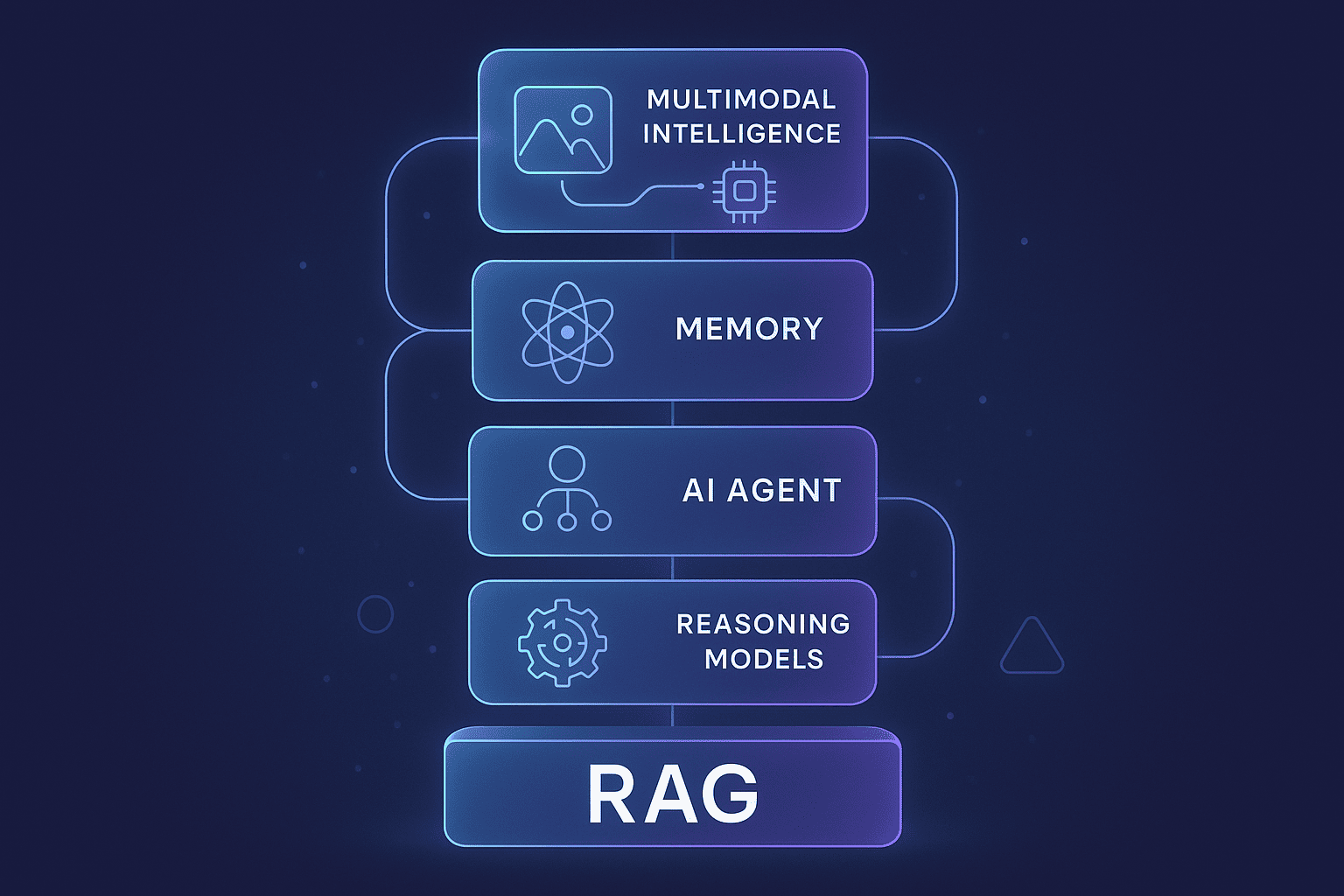
RAG + Reasoning + Memory + Actions + Multimodal capabilities.
The future isn’t “RAG vs something else” —
It’s RAG as the foundation, extended with more intelligent layers.
Related Articles
What Is a Knowledge Base in Artificial Intelligence?
This article explains what a knowledge base is in AI, how it works, why it matters, and how modern AI systems use knowledge bases for decision-making, automation, and intelligent reasoning.
December 2, 2025Essential AI Engineering Terms: LLMs, RAG, Agents, and Multimodal Models
Explore fundamental AI engineering terms like Large Language Models (LLMs), Tokenization, Vectors, Attention, Fine-tuning, RAG, Context Engineering, Agents, and Multimodal AI. Gain insights crucial for effective communication and deeper understanding in the AI space.
November 29, 2025Create Realistic Talking AI Avatars & Influencers with Consistent Results
Learn the step-by-step process to create highly realistic and consistent talking AI avatars for your brand. This guide covers generating base models with Kora Pro, creating variations with Nano Banana, and bringing them to life with advanced lip-syncing tools like VO3.1 and Enhancer
November 27, 2025